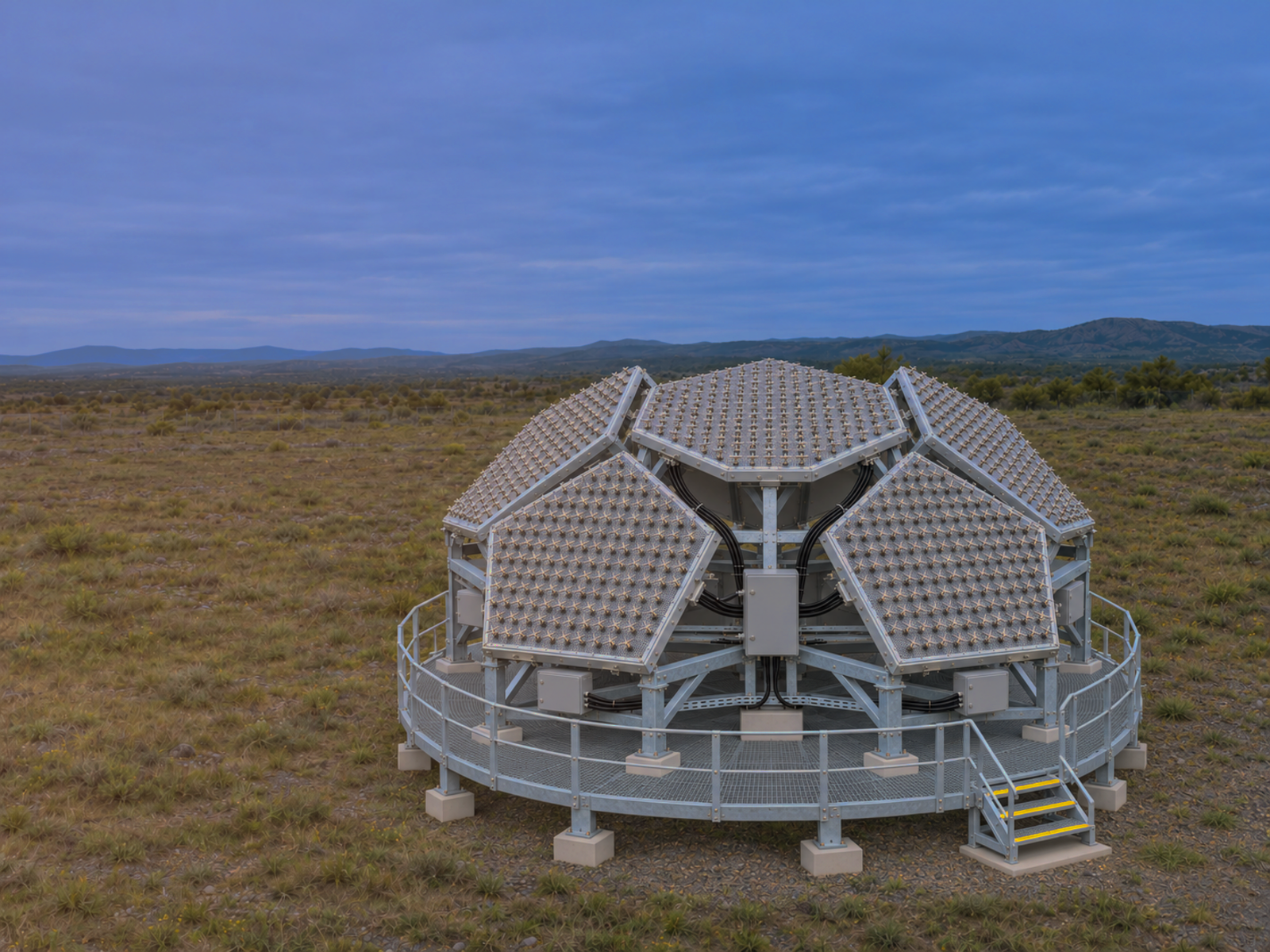

Why radio?
Radio waves can travel across enormous interstellar distances, penetrate gas and dust, and be detected from the surface of Earth with mature technology.
A sufficiently powerful narrowband transmission can also stand out from natural broadband radio emission, making radio an attractive medium for a civilization deliberately attempting to make itself detectable.
If another civilization wanted to announce its presence across interstellar distances, radio would be one scientifically plausible way to do it.

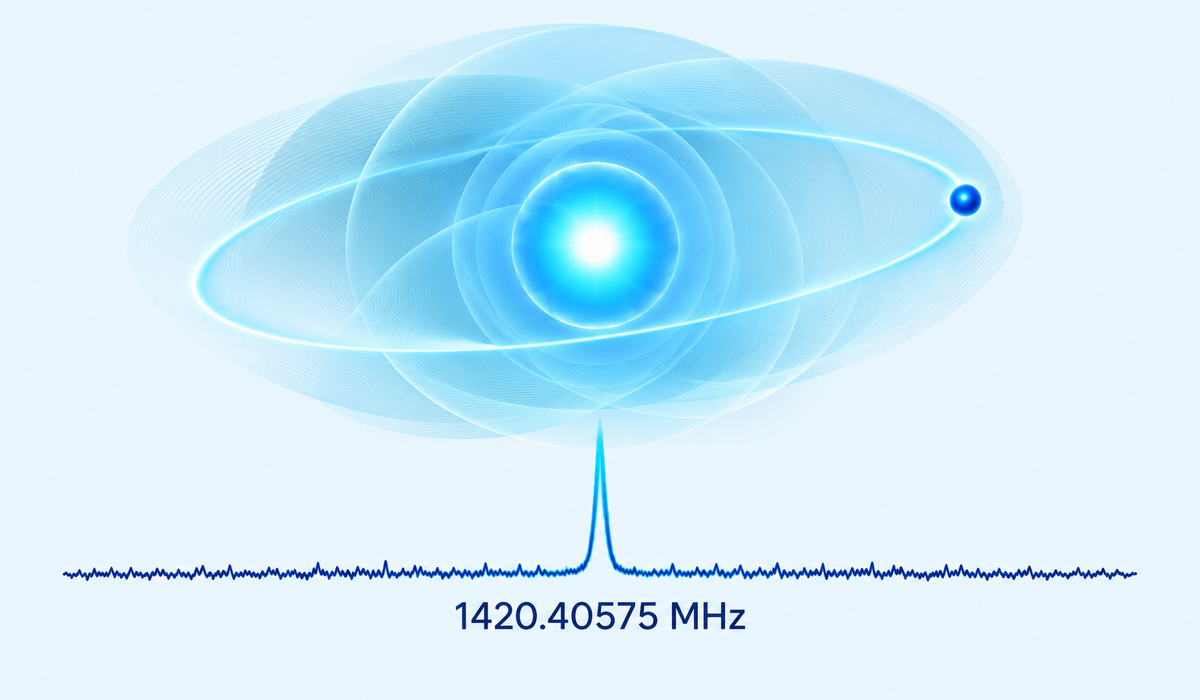
Why 1420 MHz?
A frequency written into the universe
Neutral hydrogen emits naturally at approximately 1420.40575 MHz, the famous 21-centimeter hydrogen line. Hydrogen is the most abundant element in the universe.
Any technological civilization capable of radio astronomy would be expected to recognize this spectral line, making it a natural place to listen.
Full sky. Full time.
A different way to search
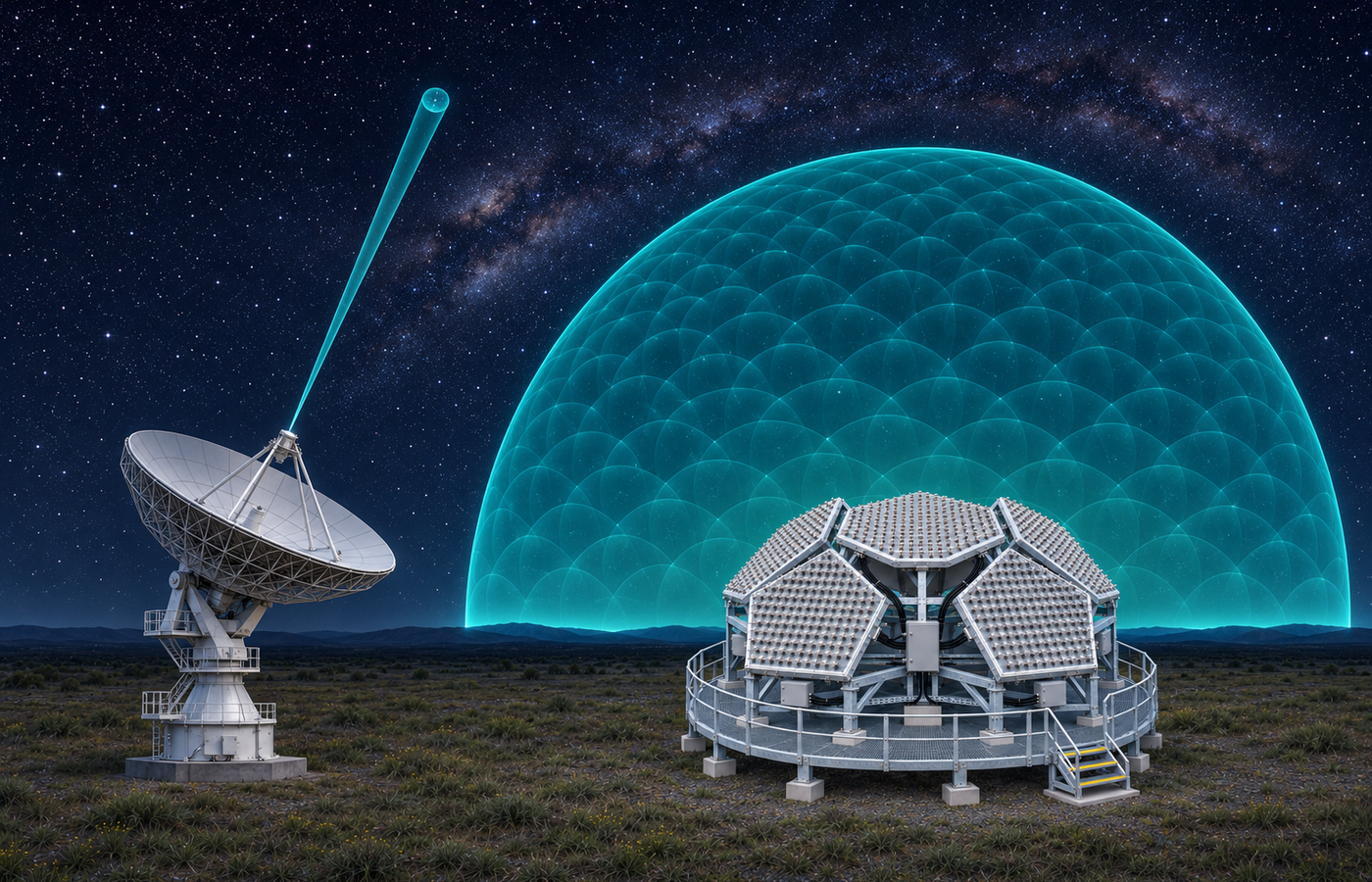
Traditional radio telescopes are extremely sensitive, but usually observe a limited region of the sky at a time. OPAA aims to continuously monitor the entire visible sky without selecting a single target in advance.

The computing problem
The telescope is only half the challenge
An omnidirectional antenna can receive signals from many directions at once. But receiving the radio sky is not the same as searching it.
Searching many directions continuously with sufficient frequency and time resolution can create an enormous computational workload. The central engineering challenge of OPAA is to find an architecture that preserves the scientific value of an all-sky search while reducing the amount of data and computation to a level modern computers can realistically process.
The OPAA telescope
Architecture under development
The exact antenna geometry, element count, beam-forming strategy and computing architecture have not yet been finalised. These are the core questions being investigated in the current project stage.
Omnidirectional
Obtain a very large fraction of the visible radio sky simultaneously.
Phased array
Combine multiple antenna elements electronically to extract directional information.
Real-time processing
Identify interesting signals without storing and processing every piece of raw data.
Scalable computing
Architecture must be capable of expanding to larger arrays and multiple sites.
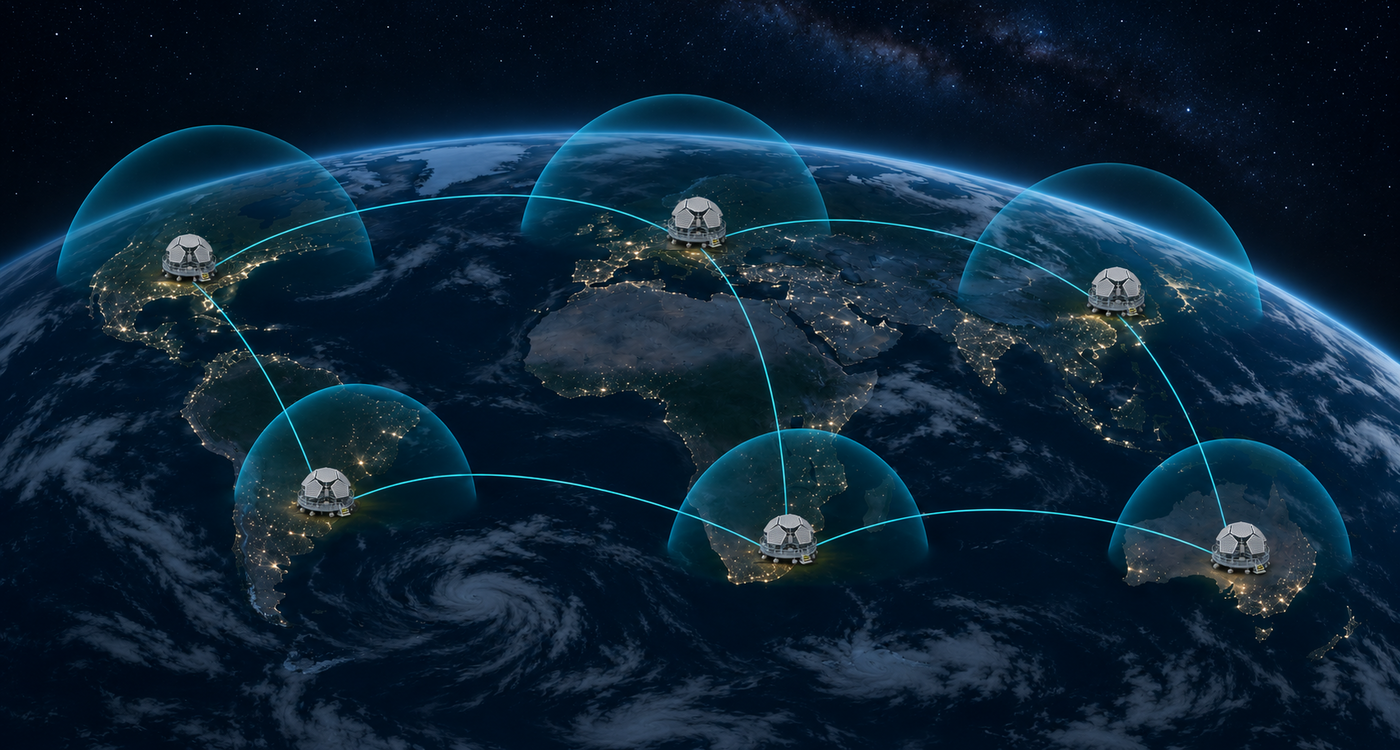
Global network
One station sees only part of the sky
A ground-based telescope cannot observe the entire celestial sphere. A network of stations at different latitudes and longitudes is required for continuous full-sky coverage and for confirming candidate signals.
Project roadmap
From an idea to a continuous global radio search
-
01
Scientific concept Completed
-
02
Architecture development Current stage
-
03
Prototype Next
-
04
First OPAA station Upcoming
-
05
Multi-site network Long-term goal
Help us build the next stage of the search
The next step is to turn the architecture into a working prototype.
We are developing the OPAA architecture: antenna-array concept, processing strategy, and computational approach for continuous full-sky radio SETI near the 1420 MHz hydrogen line.
This stage will produce a validated technical design for the first OPAA prototype.
Your support helps us complete the architecture, run simulations, and build a validated technical design for the first OPAA prototype.
A signal can arrive from anywhere.
It can arrive at any time.
We want to be listening.